What reactivity actually is
There are two common versions. The fearful dog wants the other dog gone and uses noise to create distance. The frustrated dog wants to say hello and cannot, so the frustration spills out as barking and pulling. From the other side of the street they look identical.
Either way, your dog is not giving you a hard time, they are having a hard time. And either way, the training is the same: keep your dog far enough away that they can still think, and pay them for choosing you over the other dog.
Read the ladder before the explosion
Dogs rarely go from relaxed to lunging in one step. There is a ladder, and the earlier rungs are your warning:
- Turns to look at the other dog, then back at you. Still fine, this is the good zone.
- Locks on, stops walking, ears forward, body stiff. Time to add distance.
- Lip licking, yawning, sudden sniffing of the ground, tail tucked. Stress is building.
- Raises a lip, growls, hackles up. Very close to the edge.
- Barks, lunges, spins, screams. Over threshold, and no learning happens here.
The aim is to turn around or step away at rung two, not to wait and hope. Every time your dog practises the explosion, the habit gets stronger.
The pattern to practise
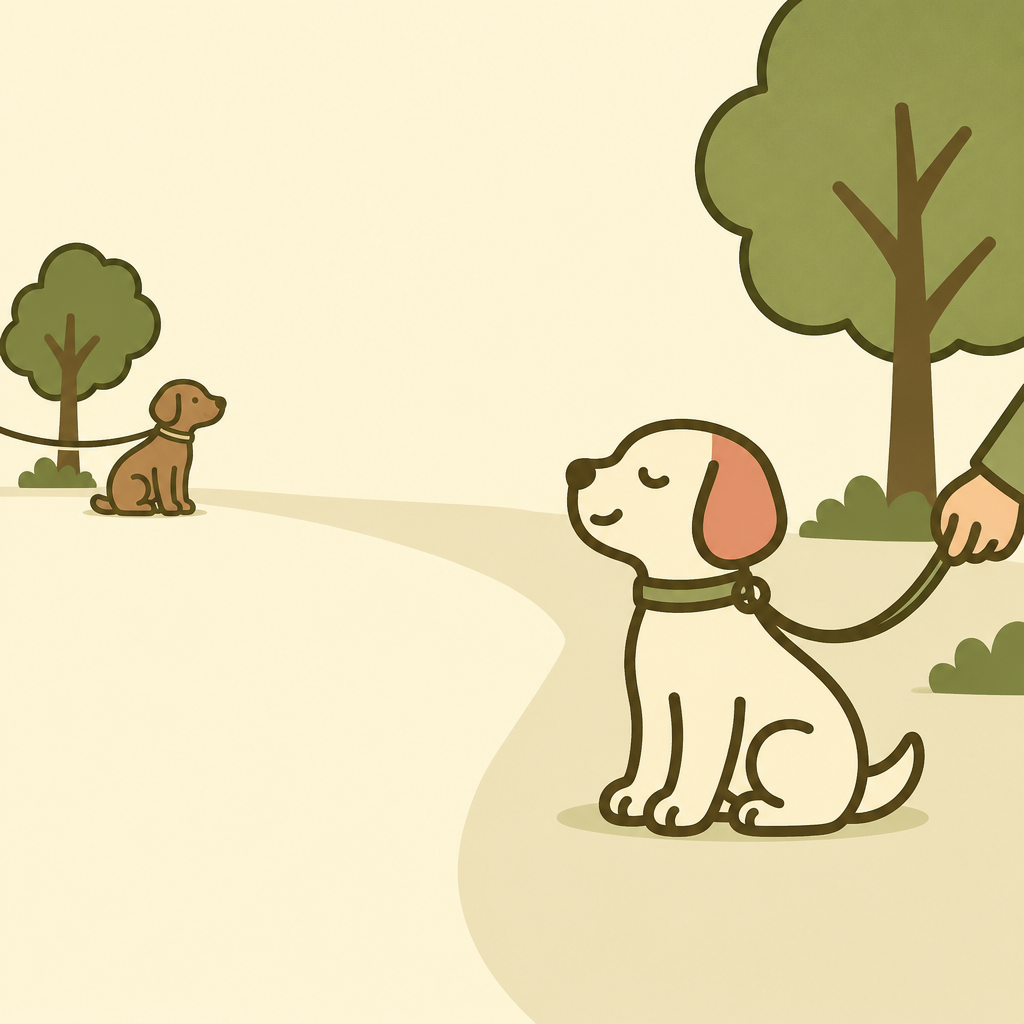
Work at your dog’s distance, with a friend and their steady dog, or in a park where dogs pass at a predictable gap. Keep sessions to five or ten minutes and finish while it is still easy.
- Spot the dog first, before your dog does, and get into position
- Say your dog’s name or a cheerful word, then feed a treat the moment they look at you
- If they look at the other dog, wait for them to look back, then treat
- Turn and walk away together while the other dog passes, feeding as you go
- End on a calm pass, not on a bark
Over weeks, close the gap by a couple of metres at a time. If the barking returns, you moved too fast. That is information, not failure.

Pupford freeze-dried training treats, beef liver
Tiny, low-calorie, mess free pieces you can feed one after another on a walk without ruining dinner.
Real walks, real dogs
You cannot control who appears around the corner, so build a small toolkit:
- Cross the road early and calmly, before your dog locks on
- Use parked cars, hedges and walls as visual barriers, and pass on the far side of them
- Teach a cheerful U-turn: say a word, turn, feed. Practise it with no dogs around first
- Keep the lead loose. A tight lead tells your dog that you are tense too
- Skip on-lead greetings with unknown dogs. A five-second nose touch can undo a month of work
If your dog does explode, do not correct, shout or yank. Move away, get distance, and let them recover. Then note what happened, because the pattern usually tells you the distance you needed.

Max and Neo triple handle traffic leash
The extra handles let you hold your dog close and steady at your side while another dog passes, instead of hauling on a single loop. Reflective too, for evening walks.

PHOEPET no-pull front-clip harness
A front clip gently turns your dog back toward you when they lunge, instead of letting them pull straight ahead. The handle is useful for holding close on a narrow pavement.
What makes it worse
Punishment adds fear to a dog who is already frightened, and fear is what drives the noise. Retractable leads let your dog hit the end of the lead at speed, which feels like a jolt. Letting every stranger dog rush up “to say hello” teaches your dog that other dogs are unpredictable. And walking the same route at the same busy time every day gives you no chance to manage distance.
Quieter times and quieter streets are not avoidance, they are training conditions.
Safety first
If your dog has ever made contact with another dog or a person, use a well-fitted basket muzzle for walks while you train. A muzzle is not an admission of failure, it is how you get your dog out safely so the training can happen. Condition it slowly with treats, at home, over a week or two.
Also use a harness and a fixed lead rather than a slip lead or choke chain, and tell other owners honestly that your dog needs space. Most people will happily give it, and a clear signal on the lead saves you having to explain at speed.

Give Me Some Space dog bandana
A friendly, wordless way to tell approaching owners that your dog is in training and needs room. Slips on over a collar.

Dexil Give Me Space yellow collar
A yellow collar that labels a dog in training at a glance, useful on narrow pavements where nobody has time to read a bandana.

Dexil Give Me Space yellow harness
A padded non-pull harness in the same yellow, with front and back rings, so the space signal stays on the dog while you work on the lead.
The optional extras, and how to use them
None of this gear trains your dog, and none of it replaces distance. What it can do is take the edge off a hard moment, which makes the training easier to do. Try one thing at a time, at home, on a calm day, so you can tell whether it actually helps.
A snug vest or ear band is worth testing if your dog gets tense on busy pavements. A sniffing session at home is the other half: the walk winds your dog up, and sniffing brings them back down again.

ThunderShirt calming vest
Gentle, constant pressure that some dogs find grounding on a stressful walk. Introduce it calmly at home first, not on the pavement.

Happy Hoodie calming band
Covers the ears and neck snugly, which helps some dogs on noisy streets and doubles as ear protection.

Snuffle mat for dogs
Ten minutes of sniffing for kibble after a walk helps your dog switch off instead of staying on alert.
When to bring in a trainer
Lead reactivity is one of the areas where good help pays for itself quickly. Look for a certified, reward-based trainer or behaviourist who will meet you outdoors and assess your dog’s distance, rather than someone who wants to correct the barking.
Seek help sooner rather than later if your dog is injuring themselves on the lead, if walks have stopped altogether, or if there has been a bite. None of that means your dog cannot improve, only that you should not do it alone.
What progress looks like
Not a dog who ignores every dog on earth. Progress is your dog seeing another dog at twenty metres and turning to you for a treat. Then at ten metres. Then walking past on the opposite pavement with a loose lead and only one glance.
That is a dog who has learned the most useful thing of all: other dogs are not your job, I am.
One more thing that some owners find helps
Flower essences are not a sedative and they will not replace training, distance or a safe space. Plenty of owners still find them a useful, gentle extra on hard days, and they are easy to add to water or food. Ask your vet first if your dog is on any medication, and never use a human calming product on a dog.

Bach RESCUE Remedy pet dropper, 2-pack
A sedative-free flower essence dropper that owners often use alongside a behaviour plan for fireworks, vet trips, travel and settling in.
More picks for this problem
Everything here is part of the calm kit. Take what fits your dog and leave the rest.
Snuffle mat for dogs$18.99 on AmazonThunderShirt calming vest$45.99 on AmazonHappy Hoodie calming band$13.99 on AmazonWith love & gentle paws, Nikki B